
Red Imported Fire Ants (Solenopsis invicta)
Red Imported Fire Ants (RIFA) are a highly invasive, non-native species to Bermuda. They were first reported at a private residence in Hamilton Parish in November 2025. A second colony was discovered on the cargo dock in the City of Hamilton a month later. Both colonies were promptly treated with approved pesticides, however DENR is concerned that unreported fire ant colonies exist on Bermuda and eradication can only occur it they are destroyed before they can spread to other locations
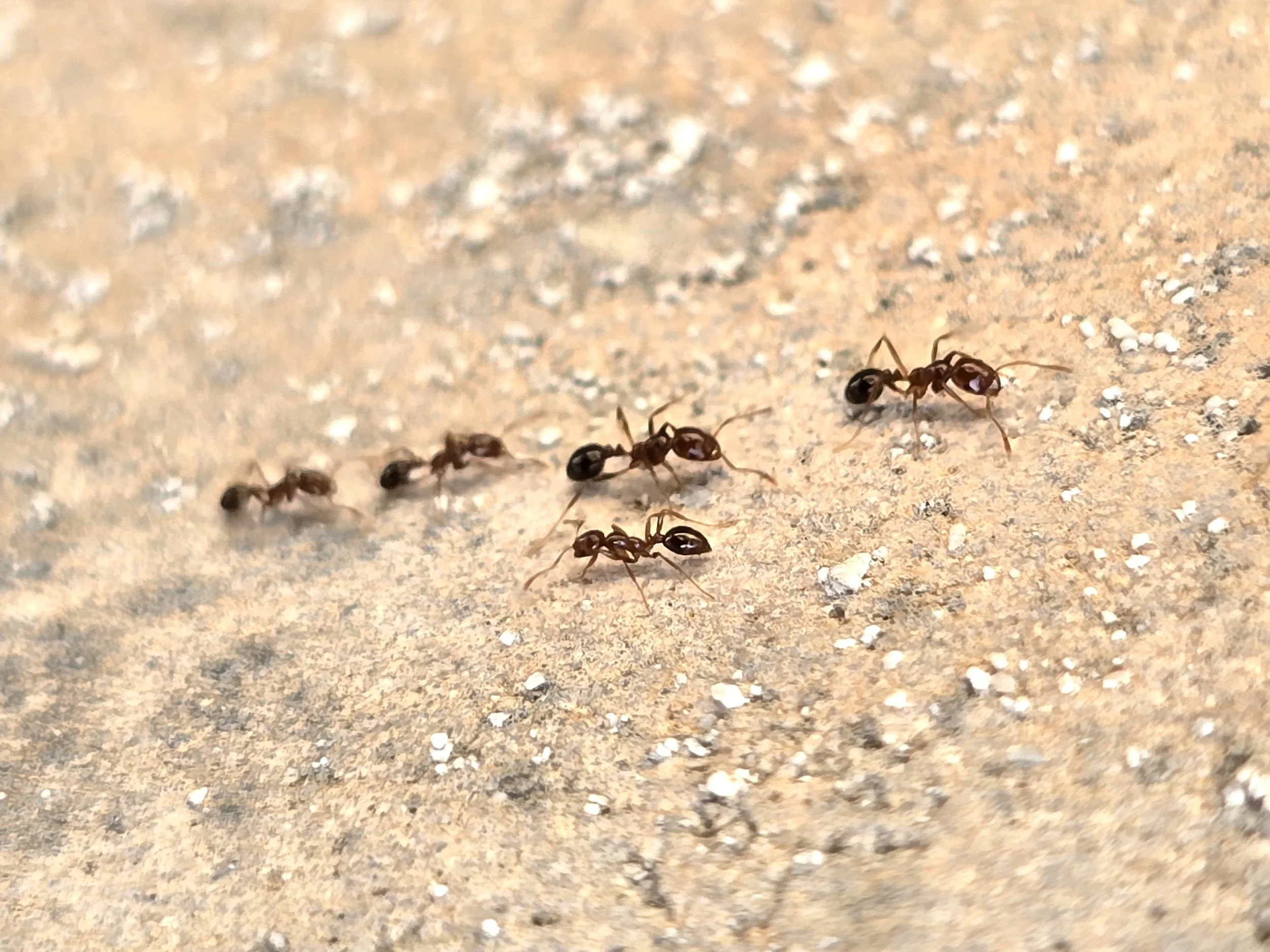
Photo credit: Justin Tavares
What to look for
Fire ants are up to 6 mm long with a reddish-brown head and thorax and a dark abdomen. Different sized individuals can be found in a single colony, but the largest workers are the ones who actively forage and defend the nest.
It is easy to confuse fire ants with other locally established ant species, especially the big-headed ant (Megacephala spp.) and the trap-jaw ant (Odontomachus ruginodis). Big-headed ants are widespread across Bermuda, and the major workers have heads noticeably larger than their abdomens. This is not the case with fire ants whose heads are about the same size as their abdomens. Trap-jaw ants are twice the size of fire ants and have much longer jaws.
The red imported fire ant builds underground nests in almost any type of soil, but prefers open, sunny areas such as pastures, parks, lawns, golf courses, pastures and cultivated fields. The shape and size of the nest depend on the type of soil the ants burrow into and the size of the ant colony. During the early part of colony development, the nests can look like loose soil scattered over grass. More mature colonies will form visible mounds composed of organic materials (e.g. soil, sand, small pieces of wood). Neither have obvious entry holes.